A $4K Audit Uncovered $10.4M in Additional Revenue Capacity
Same headcount. Massive growth.
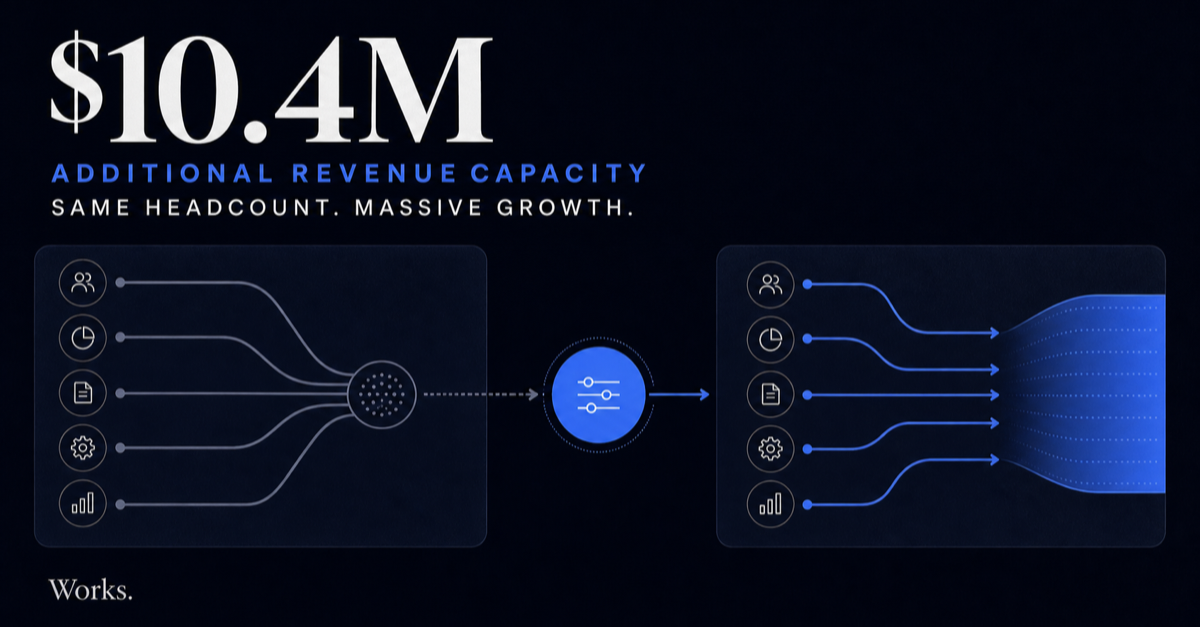
A client committed $30,000 to an AI transformation engagement with us.
The first $4,000 funded the workflow audit. It uncovered capacity for an additional $10.4 million in revenue.
We found it by understanding how the business actually works, identifying the constraints and calculating what becomes possible when those constraints are removed.
Before we began, the CEO told me about a conversation with their IT managed service provider.
"They said, 'We can build anything. Just tell us what you want.'"
His response was perfect.
"Mate, I don't know what I want. That's the point."
That is the problem. The value is not in waiting for a client to design the solution. The value is in understanding the business well enough to identify where AI can create value, then turning that opportunity into a buildable plan.
We started with the work, not the tools
We began with a comprehensive analysis of the client's workflows. That meant sitting beside the people doing the work, watching real tasks move through real documents, systems, decisions and handoffs.
No tool demos. No brainstorm about agents. No shopping list of software the business supposedly needed.
We followed the work from the moment it entered the business to the point where it created value. We mapped what triggered each process, what information people needed, where judgment mattered, who owned the handoffs and what had to be checked before the work could move forward.
The polished process diagram rarely tells you any of that. The real workflow lives in the second spreadsheet, the missing field, the manual check and the message to the one experienced person who knows whether something looks right.
That is where we found the value.
We found the constraints hiding inside ordinary work
Most inefficiency does not look dramatic from the inside. It looks normal.
Information gets typed twice. A task waits because ownership is unclear. A document gets rebuilt from an old version. A quality check depends on memory. A commercially important process moves at the speed of the busiest person in the company.
Each problem looks small in isolation. Across a whole workflow, they compound into slower delivery, missed capacity and revenue the business cannot reach.
We did not treat every irritation as an AI use case. We ranked the opportunities by commercial value, operational friction, implementation difficulty and the business's ability to check the result safely.
That produced three buckets:
- Build now, where the pain was real and a narrow solution could create measurable value
- Measure first, where the opportunity looked promising but the baseline was weak
- Park, where permissions, data or system constraints made the idea a distraction
The goal was not to create the longest possible roadmap. It was to find the first constraint worth removing.
We turned the audit into a build plan
An audit that ends with a strategy deck is just expensive stationery.
The audit gave us a specific build plan for the highest-value workflows. It defined what needs to change, what information the system needs, where AI genuinely improves the process and where human judgment must stay in control.
Delivery comes next. We will build the smallest useful version and test it with real work. Not a lovely synthetic example built for a demo. The awkward jobs, edge cases and imperfect inputs people deal with every week.
The new system will run beside the existing process so we can compare the outputs, fix what breaks and expand the boundary only when the evidence supports it.
The technology matters, but it is not the product. The product is a better way for work to move through the business.
The first model was $5.2 million. The CEO and COO showed me why it was $10.4 million.
When I presented our model, I put the value unlocked at $5.2 million in additional revenue capacity.
The CEO and COO jumped me immediately.
"That's wrong."
Nightmare material.
Then they explained why. My model counted the 120 days of capacity the changes would return to the business. It did not count that the new workflow would also let them finish the work in half the time.
So the number was not $5.2 million. It was $10.4 million in additional revenue capacity.
To be precise, that is capacity identified by the audit, not revenue already delivered. The delivery work comes next.
That distinction matters. We are not selling magic. We are finding value trapped inside the way a company operates and building the systems required to release it.
What clients actually buy from Works
Clients do not hire us for a list of AI ideas. They hire us to move from curiosity to measurable operating results.
That means:
- Seeing how the business actually works, not how the process manual says it works
- Finding the workflows where time, capacity or revenue is being lost
- Ranking opportunities by value and buildability
- Redesigning the process before automating it
- Building and testing the solution against real work
- Keeping people in control where judgment matters
- Measuring the result in terms the business cares about
Sometimes the first win saves hours. Sometimes it removes risk. Sometimes it unlocks a revenue opportunity big enough to change the company's trajectory.
The common thread is that we start with the business outcome, not the technology.
If you know AI should be creating more value inside your business, but your team is still stuck between experiments, tools and a long list of ideas, drop me a line.
We will look at how the work actually moves, find the constraint worth solving and build the system that turns it into a commercial result.
Let's get to Work!
What could your business unlock?
Works audits how work moves through your business, ranks the opportunities and turns the best ones into a delivery plan. Audits start at $4K.
Book a call →