Skills Are the Last Layer
Layer 4. Everyone wants the skills first. A skill is a verb, context is the noun, and a verb with nothing to act on is useless.
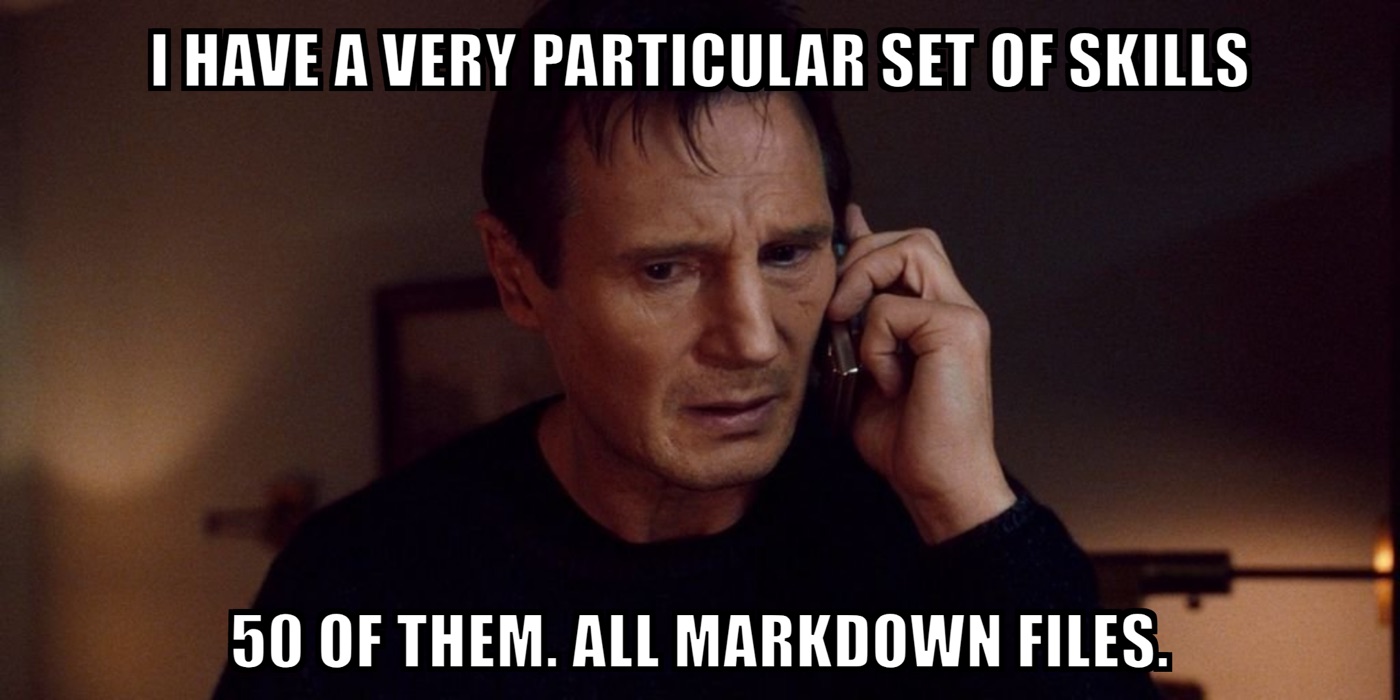
Everyone wants the skills first. Skills are the last thing you should build.
Why does everyone want the skills first?
I shared my AI stack in What an AI-Native Company Actually Looks Like (June 2026), and everyone got excited by the same thing. The skills. I've got more than 50 of them, each one a specialist I can call on by name. And everyone who sees them wants their own particular set of skills. They want to be Liam Neeson in Taken, the guy on the phone rattling off exactly what he can do to whoever's on the other end. Fair enough. That's the fun part.
So what is a skill, really? And why is building it first the mistake almost everyone makes?
What is an AI skill, really?
A skill is a single markdown file. That's it. It's an SOP, written in plain English, that a model runs on command. /payroll walks my whole pay run and spits out the Xero instructions. /sweep triages my pipeline and my calendar before I'm awake and tells me what to dispatch, prep, or skip. /gtm-audit runs the full audit workflow I used to do by hand for clients. /share-deck takes an HTML deck and deploys it to a live URL in thirty seconds. /fec-fill goes and finds fractional operators and loads them into a sequence. Each one is the kind of thing I'd have written a Notion doc for and then never followed. Now a model follows it for me, exactly the same way, every time.
That's the appeal. You watch one run and you immediately want fifty of your own.
Why is a skill a verb, not a noun?
But the part that matters didn't make the carousel. A skill is a verb. /draft, /audit, /enrich, /prep. And a verb with nothing to act on is useless. /linkedin writing a post about my business is only worth a damn because underneath it sits a voice guide, a story bank, a folder of what's worked and what flopped, the actual texture of how I sound. The skill is the verb. The context is the noun. Run the verb with no nouns underneath and you get generic slop with my name on it.
Why do custom GPTs flop?
This is exactly why everyone's custom GPTs flop.
People build the clever verb first. A "sales email writer." A "meeting summariser." Then they point it at a blank business and wonder why the output reads like every other AI email on earth. They built the verb and skipped the noun. The skill had nothing real to stand on.
It's the same mistake in a different costume to the one I keep seeing inside companies. Everyone wants the flashy agent that runs the business while they sleep. Nobody wants to build the boring folder of context that the agent needs to not be an idiot.
What order should you build the layers in?
So the order matters, and it's the opposite of what feels natural. You build the architecture first, where the AI sits inside the business. Then the context, what it knows before you type a word. Then you train the people. And only then, on top of all of it, do you build the skills. By that point a skill is two paragraphs of instruction, because everything it needs to be good already exists underneath it. Build it in the other order and every skill is a fight.
Do you need a dev team to build 50 skills?
I've got more than 50 of these now and I still can't write a line of code. They didn't take a dev team. They took a year of building the layers underneath them first, so that when I finally wrote the skill, it had something real to run on.
That's the whole game. The skills look like the magic. They're just the last layer. The work that makes them work is the stuff nobody screenshots.
This is the order we build in at Works. Architecture, context, capability, then skills on top. If your team has a pile of AI tools and nothing sticking, it's almost never the tools. It's that there's nothing underneath them.
Let's get to Work!
Want this installed in your business?
Works embeds an operator who builds the layers into how you already work. Architecture, context, the brain, your team trained, then the skills on top. It starts with a 30-minute chat.
Book a call →Or try the Skill Library Generator → Describe a repeated task, get a starter skill.
Or start with the Works AI Audit → Fixed price: $5K for up to 50 people, $10K above that, and a build plan ranked by ROI that's yours either way.