The AI Architecture Layer: The Folder Structure That Makes AI Stick
Layer 1: Architecture. The plumbing. Where the AI sits, how it's wired: folder structure, project brains, and the maintenance loop that keeps it all current.
AI architecture is where the AI sits inside your business and how it's wired in. In practice it means your folder structure and your filing system: the shape of the business, written down as files a model reads before you type a word. It's the least glamorous of the four layers, and the one that decides whether everything above it works.
I call it AI Brutalism. Brutalism is the architecture of raw concrete and exposed structure. No cladding, no decoration, nothing hidden. The building is honest about how it's built, and people either love it or call it ugly. The strongest AI setup looks exactly the same. Ugly, structural, no shiny bits, just folders and markdown doing the work that looks like magic from the outside.
In Skills Are the Last Layer (June 2026) I made the case that skills are the last thing you should build. A few people asked the obvious next question: if skills are last, what comes first? This layer does. Architecture comes first because everything else lives inside it.
What problem does AI architecture solve?
The problem it solves shows up the moment you start. Most people open Claude or ChatGPT from zero every single time. They re-explain who they are, what they sell, how they talk, who the customer is. The model is sharp for that one conversation and then it forgets all of it. Tomorrow you do it again. You're the bottleneck, retyping your own business into a blank box forever.
Architecture kills that. You build the business once, as files, in a structure the model reads before you type a word.
What does the folder structure actually look like?
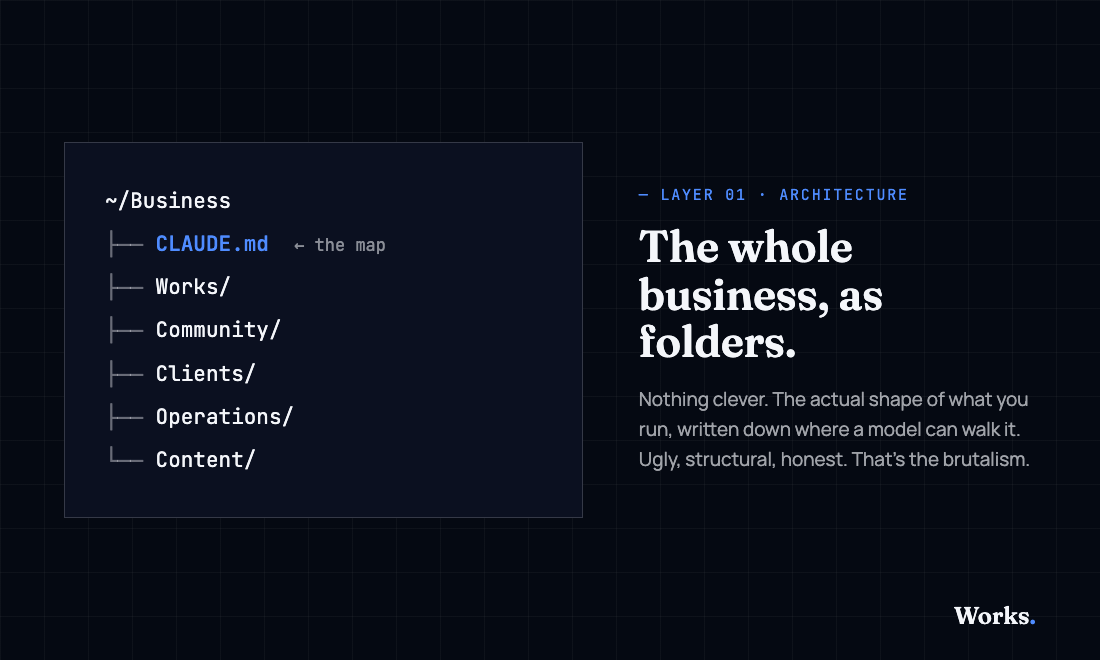
Mine is just folders. One for each part of the business. Works. The community. The clients. Operations. Content. Nothing clever, just the actual shape of what I run, written down where a model can walk it.
What goes in a CLAUDE.md file?
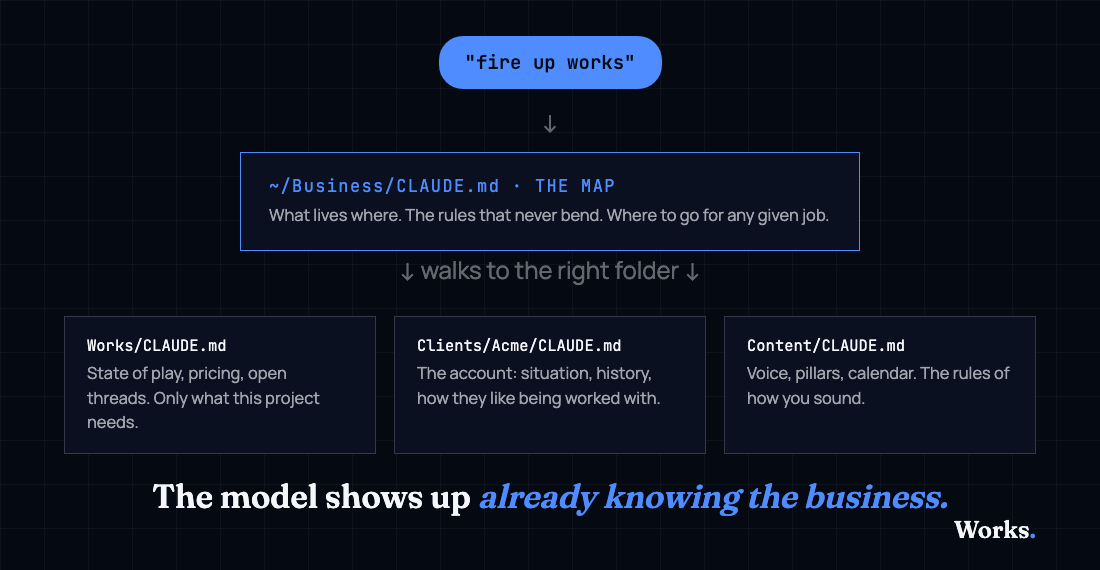
At the root sits a single file. A CLAUDE.md. It's the map. It tells the model what lives where, the rules that never bend, and where to go for any given job. Then inside every project folder sits another one. A CLAUDE.md scoped to that project, holding the context that only matters there. The client's situation. The state of play. How they like being worked with.
So when I open a conversation about a specific client, the model isn't guessing. It reads the root map, walks to that client's folder, loads that client's context, and shows up already knowing the account. I've built a specific rule so I can talk to it in natural language. I just say "fire up works" and the LLM loads all the context.
Can a file actually enforce a rule?
I called them the rules that never bend. Honest caveat, because it matters: a rule in a file is a strong instruction, not a lock. The model follows it almost always, and when the rule is "never email a client without me," almost isn't good enough. The rules that genuinely can't break get enforced a layer deeper, in code that runs no matter what the model decides, not words it reads and usually obeys. That gets its own section in The Brain.
Why does scoped context beat one giant file?
Two things come out of that. The first is persistent context. You build it once and it's there every session, so the model never starts from scratch again. The second is scope. Each significant project gets its own folder, so the AI loads only what that job needs, not every file across your whole operation. That's the actual skill: managing context. Not too big, not too small. The Goldilocks of context. Hand it your entire business to write one client email and it drowns in noise. Hand it nothing and it guesses. The folder structure is how you give it exactly the right amount, every time.
That's the whole idea. The model starts every conversation as a senior operator who already knows the business, instead of a stranger you have to brief.
How do you keep the architecture from going stale?
People build this once, feel like a genius for a week, and then never touch it again. Three months later it's a museum. The pricing changed, the positioning moved, the client churned, and the files still say otherwise. Stale context that looks authoritative is worse than no context. It's how a confident model gets it confidently wrong.
So the architecture has to maintain itself, and that's a job for two skills, not for discipline. At the end of a working session I run /debrief. It writes the decisions and changes straight back into the project files. Then /reflect captures what I learned about how to work better with the files, and saves that too. The business changes, the files change with it, including the skills I run. It happens automatically, a side effect of doing the work. The architecture stays alive because updating it is part of the loop, not a chore I have to remember. That's compound learning. It's where you really start to power ahead with AI.
Does this scale from one person to a whole company?
This approach works as a personal setup with purely local files, but the same structure scales to a whole company. A shared brain the entire team builds on, instead of one person's folders. That's a whole other post, but the short version is you put the folders somewhere the team shares. GitHub, Dropbox, Google Drive, OneDrive, they all work. The one requirement is that you can mirror the files locally.
Why build the architecture layer before agents and skills?
This is why at Works, this is where we start every client. Not with a shiny agent. The agent everyone wants, the one that runs the business while you sleep, is sitting at the top of a stack. Underneath it is the skill. Underneath the skill is the context. Underneath the context is this. The folders, the CLAUDE.md files, the maintenance loop. Build it first and everything above it gets sharper for free. Skip it and every clever thing you build on top is standing on sand.
It doesn't demo well. It's folders and markdown, raw and exposed, the brutalist layer of the whole stack. No animation, no viral screenshot. It's what decides whether your AI grows into a colleague that compounds, or never gets past a party trick.
How do you start this week?
Three things to do this week if you're running AI in your business.
First, make one folder for your business and drop a CLAUDE.md in it. Five lines. What you do, who you serve, how you talk, the rules that never bend.
Second, give each real project its own folder and its own CLAUDE.md. Scoped context beats one giant file every time.
Third, decide how it stays current before you need it to. A skill, a habit, a Friday ten minutes. Pick something, because the version of this that goes stale is the version that quietly makes your AI worse.
The folders are the boring part. They're also the part that does the work.
This is the first layer we build at Works. Architecture, then context, then capability, then skills on top. If your team has a pile of AI tools and nothing sticking, it's almost never the tools. It's that there's nothing underneath them.
Let's get to Work!
Want this installed in your business?
Works embeds an operator who builds the layers into how you already work. Architecture, context, the brain, your team trained, then the skills on top. It starts with a 30-minute chat.
Book a call →Or take the AI Readiness Scorecard → Ten questions, a 0-100 score.
Or start with the Works AI Audit → Fixed price: $5K for up to 50 people, $10K above that, and a build plan ranked by ROI that's yours either way.