What an AI-Native Company Actually Looks Like
I built one: a one-man practice doing $400k+, run almost entirely on AI. The full machine, layer by layer, and why yours wouldn't look like mine.
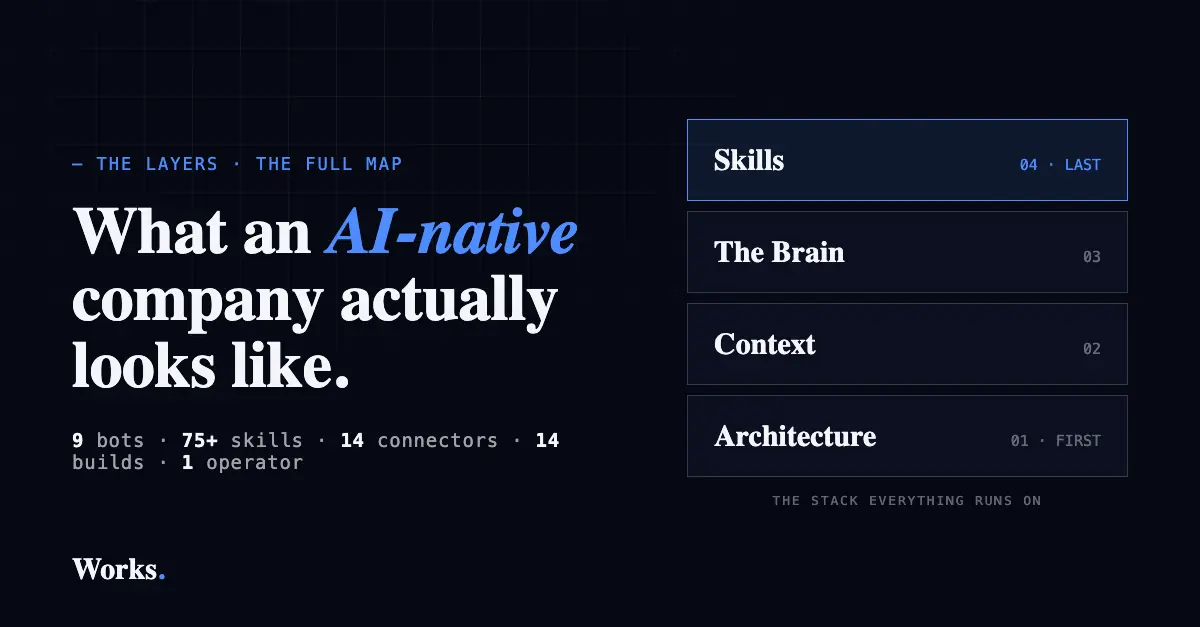
An AI-native company is a business where AI is wired into how it actually operates. Not a tool people remember to switch to, the layer everything runs on. I built one. My fractional practice was a one-man operation doing $400k+, and it ran almost entirely on AI. No team behind me, just a stack I put together myself.
Most of what gets written about "AI transformation" is theory from people who haven't wired one together. So instead of theory, here's the actual machine. What's under the hood, what each layer does, and why yours wouldn't look like mine.
What runs before I wake up?
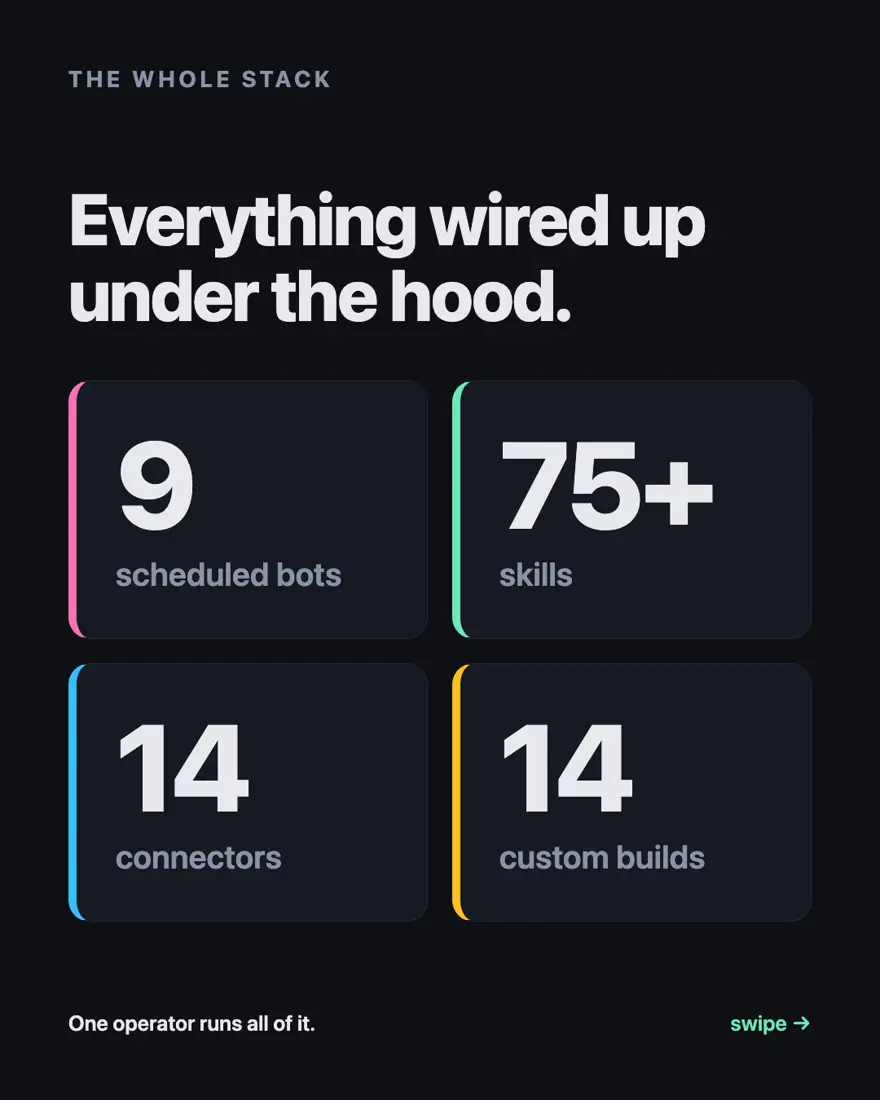
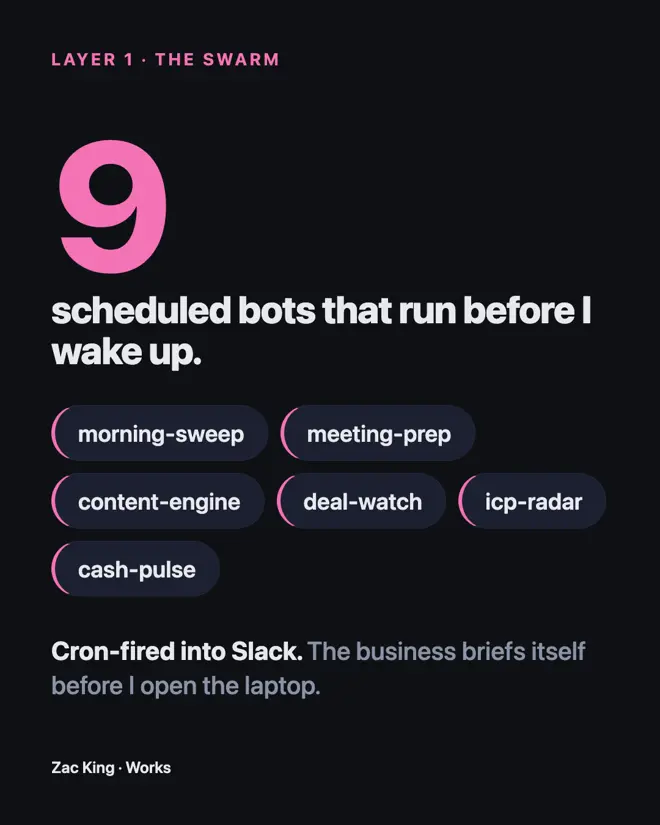
Nine scheduled bots run before I've had coffee. One triages the pipeline and tells me which deals need touching today. One preps every meeting on the calendar with context pulled from past calls and emails. One watches my community overnight and matches job posts to members. One drafts content. By the time I sit down, the morning brief reads like a chief of staff prepared it. Because one did. It's just not a person.
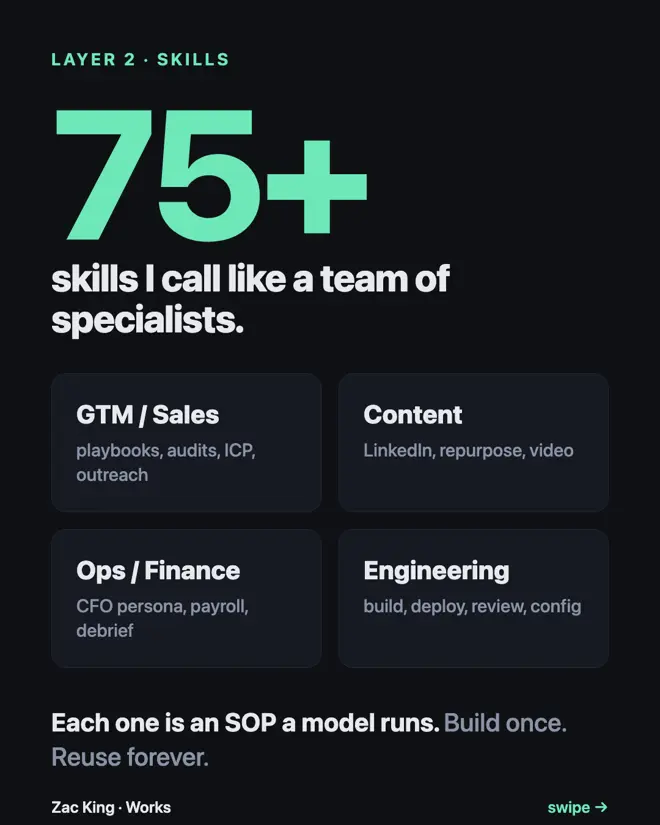
Through the day I work with more than 75 skills. A skill is basically an SOP a model runs on command: write the LinkedIn post in my voice, run the payroll calculation, qualify this deal against my ICP, build the client research pack. Each one carries the judgment I'd otherwise have to apply by hand, written down once, run forever. It's the closest thing a one-man business gets to a team of specialists.
All of it plugs into the 14 tools the business already lives in. Attio, Gmail, Slack, Stripe, Granola, Drive. The AI isn't a separate place I go. It reaches into the systems where the work already happens.
And where something didn't exist, I built it. Fourteen custom tools and apps. A community bot answering member questions at 2am. A finance agent that models cash flow. An engagement tracker that tells me which prospect read which slide of a proposal. I still can't write a line of code. All of it came out of a year or two of rabbitholing. (It feels like ten years tbh, IYKYK.)
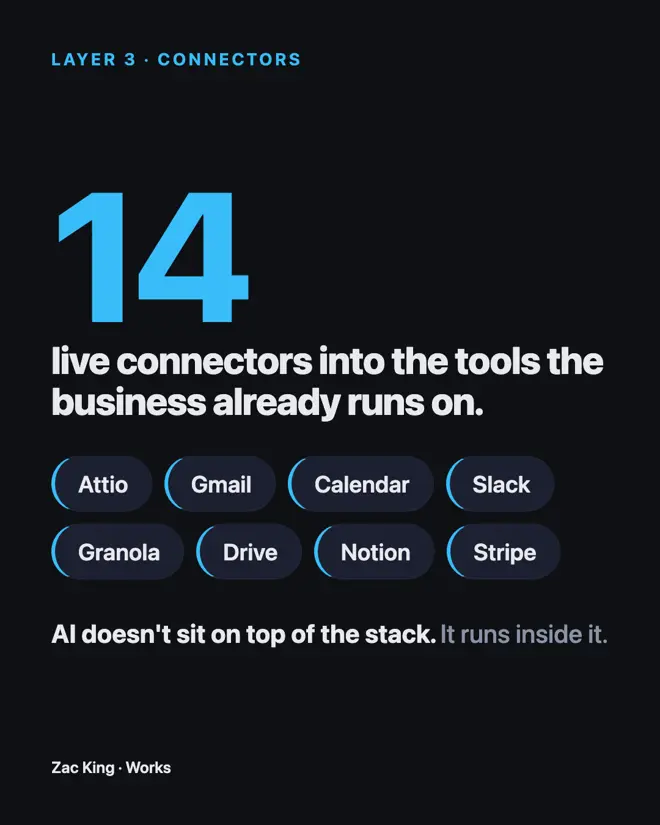
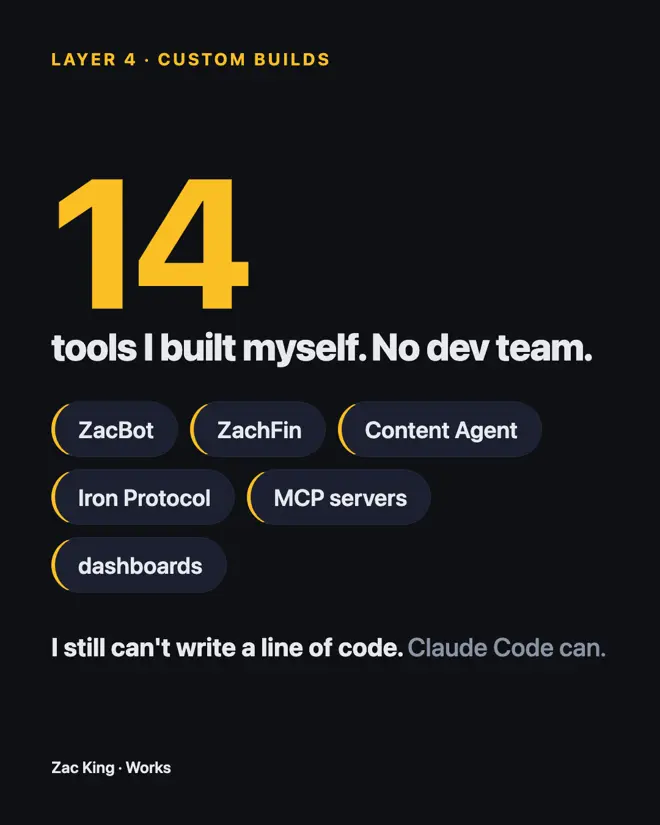
From the original stack map. The live, clickable version: stack-map.workshq.com.au
Why do most companies end up AI-tourists instead?
The reason I'm telling you about my stack is what happened every time I described it to founders and CEOs. They'd lean in, and then they'd tell me the same story, almost word for word.
They'd bought everyone a seat. The whole team had a license. The vendor came in and ran a workshop. And six or twelve months later, usage was still sporadic. A few people summarising emails. One enthusiast doing something clever nobody else could repeat. No cohesive, strategic use of AI anywhere in the business.
That's not AI-native. That's AI-tourist. Visiting the technology, taking a few photos, going home to work the old way.
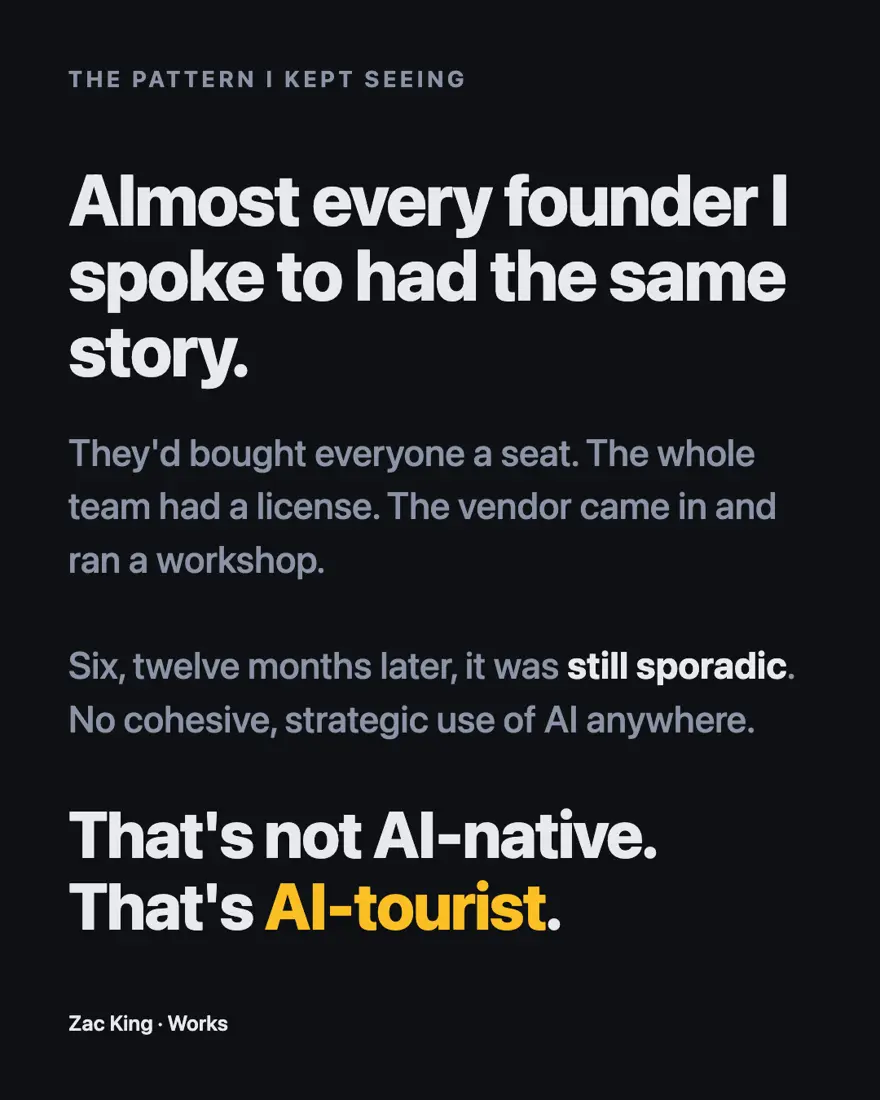
The difference isn't the tools. The tourist companies often had better tools than me. The difference is that nothing was wired in. AI sat next to the business instead of inside it.
What are the four layers of an AI-native company?
Being AI-native means the AI is wired into how the business actually operates, not sitting beside it. Every working version of this I've seen, mine included, stacks the same four things in the same order.
Architecture
Architecture is where the AI sits and how it's wired in. Unglamorously, this is your folder structure and filing system, the shape of your business written down where a model can walk it. I've written about this layer in The AI Architecture Layer. It's first because everything else lives inside it.
Context
Context is the business, captured as files the model reads before you type a word. Who you are, what you sell, how you talk, what's true right now. This is what kills the blank-box problem, where you re-explain your own company to a machine every morning, forever.
The brain
The brain is context organised so it stays alive. A map at the root, scoped knowledge in every project, and maintenance loops that write decisions back into the files as a side effect of doing the work. A brain that doesn't update isn't a brain, it's a museum.
Skills
Skills come last, deliberately. They're the SOPs that run on top of everything below. Skills built on a real brain perform like senior hires. Skills built on nothing perform like interns with confidence. I've made that argument in full in Skills Are the Last Layer.
Tools never appear on that list, and that's the point. Claude, ChatGPT, Gemini, whichever. Tool choice is downstream of architecture. The layers are the asset.
Why wouldn't your AI-native company look like mine?
That's the part everyone misses. My stack is shaped around a one-man GTM practice, so it's heavy on pipeline, content and client delivery. A 40-person operations business would build something completely different on the same four layers. Different bots, different skills, different brain. Same architecture underneath.
Which is exactly why off-the-shelf "AI solutions" keep turning companies into tourists. You can't install someone else's operating layer any more than you can run your business on someone else's org chart.
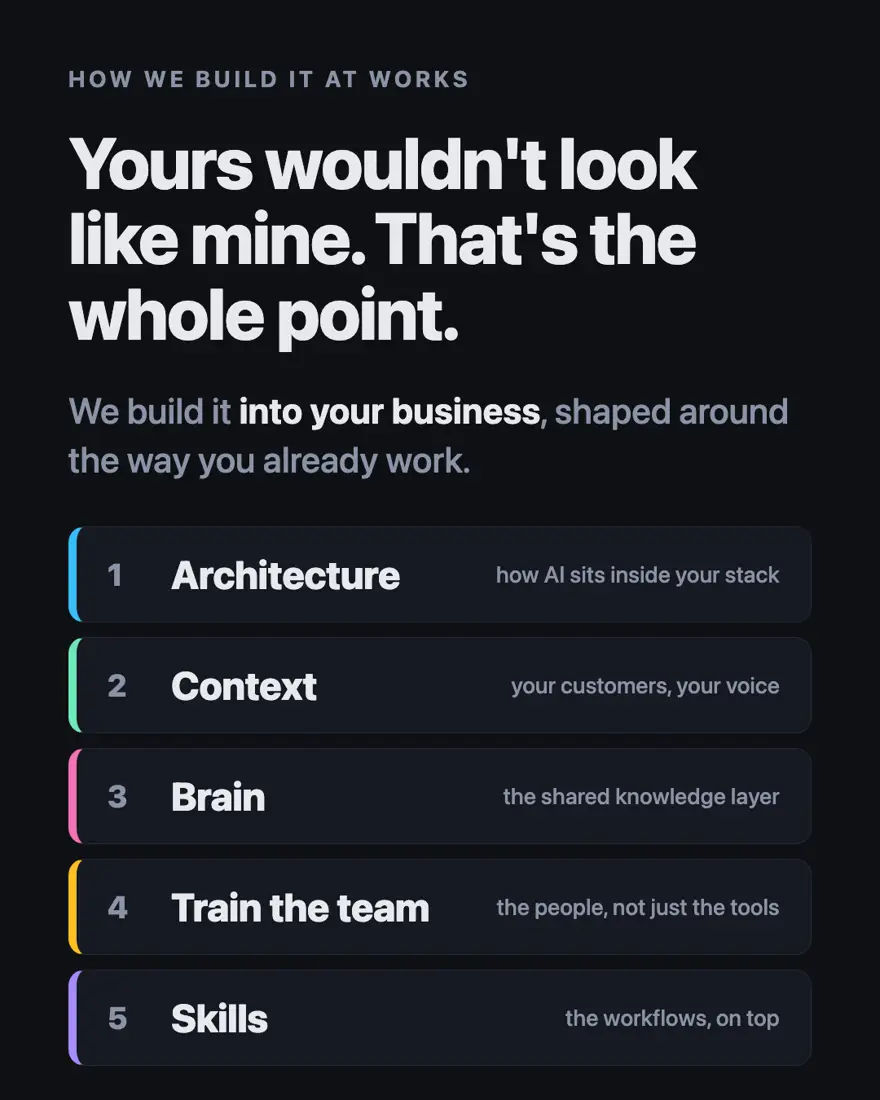
This is the problem Works exists to solve. We go into Australian businesses and build the layer into how you already work. Architecture first, then context, then the brain, train the team, and only then the skills on top. The stack you've just read about is the proof it works. The product is yours.
If your business is sitting on AI tools and seeing nothing back, that's the gap we close. Hit me up.
Let's get to Work!
Want this installed in your business?
Works embeds an operator who builds the layers into how you already work. Architecture, context, the brain, your team trained, then the skills on top. It starts with a 30-minute chat.
Book a call →Or score yourself on the Founder Dependence Index → 12 questions, how much of the business runs on you.
Or start with the Works AI Audit → Fixed price: $5K for up to 50 people, $10K above that, and a build plan ranked by ROI that's yours either way.