The Company Brain: The AI Layer That Knows Your Business
The model isn't the unlock. It never was. The context layer is. A company brain is the part that's yours: your own knowledge, codified to the part that matters, mapped so the AI pulls the right slice, and kept alive so it never goes stale.
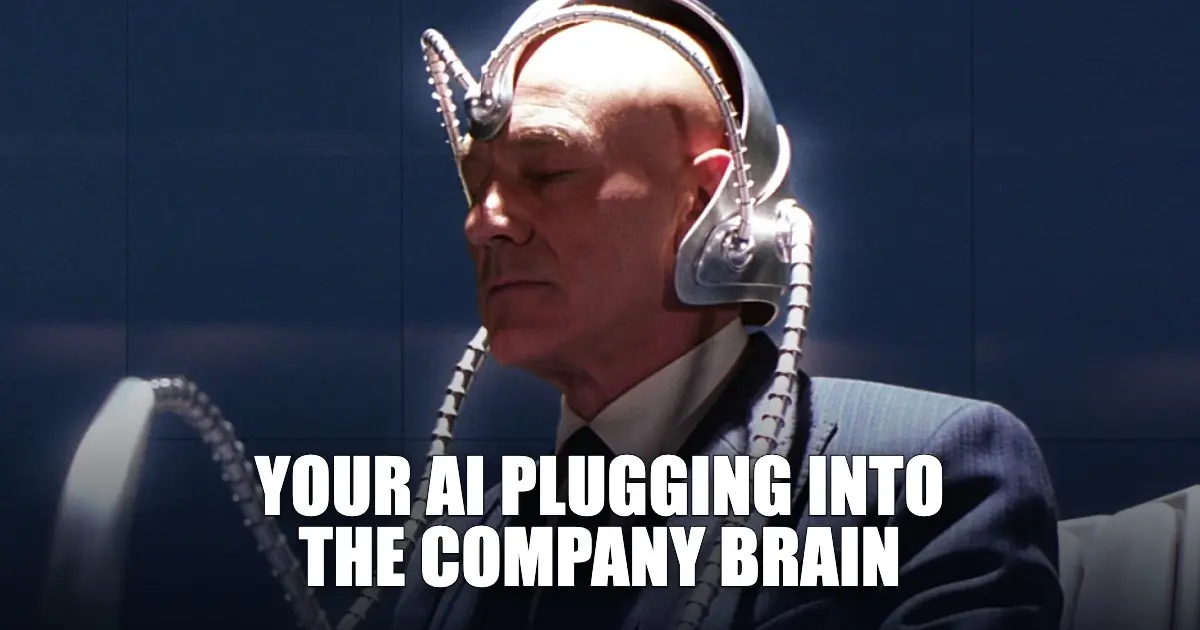
Hand a good model your business as files, organised properly, and something clicks. It walks into every task already knowing who you are, who you serve, how you price, how you sound. Not a stranger you have to brief from scratch every morning. A senior operator who has been here for years and remembers all of it.
That is the brain. Your company's own knowledge, written down, distilled into clean files, mapped so the model pulls the right slice, and kept current as you work. It is the layer everyone wants and almost nobody builds, because it is invisible, and because it is work.
The context layer is everything your AI can see. The brain is what's yours.
Layer 2 was the context stack: everything your AI can see the moment it acts. Your files, your live wires into Gmail and the CRM, the web it can reach out and fetch. Three sources, and one of them was the persistent files I called your company brain. This is that source, made precise.
The brain is the part of the stack that belongs to you. Not borrowed from a tool, not fetched from the web. Your own knowledge, codified and owned. It is the narrowest part of the context layer and the most valuable, because it is the part nobody else can hand you.
Dumping every document you own into one shared folder is a perfectly good first move, so do it. Get everything in one place, because that pile is your raw material. It just is not a brain yet. A pile is a storage unit: it is all in there somewhere, but nothing knows where anything is, and half of it drifts out of date the moment your pricing or positioning moves.
Turning that pile into a brain is exactly what the AI is best at. You hand the model the heap and put it to work: read everything, decide what matters, distil it, file it, and write a map so the right slice surfaces on demand. Order from chaos is the thing these models do better than almost anything else. That is what turns a storage unit into a brain.
What makes it a brain
It is a filing cabinet, not a pile. A filing cabinet can hold your entire company and still be fast, because you never tip the whole thing onto the desk. You open one drawer and pull one folder. The brain works exactly like that. A map at the root tells the AI what is filed where, and every folder holds its own file, so when you ask for a client email it opens that one client's folder and nothing else. Index first, load narrow. Every model gets worse the more you cram into a single conversation, so the whole skill is never loading the whole cabinet at once. The cabinet can be huge. The desk stays clear.
You file clean notes, not raw paper. What goes into a folder matters as much as the filing. You do not shove a forty-page report in whole, you file the half-page that actually matters and leave the rest in the archive. A brain is refined signal, not a copy of the dump. Each file is the short brief a sharp operator would read before they start, not the stack they would have to wade through. That is the difference between a brain and the storage unit it grew out of.
It is alive. The AI reads it, and it writes back to it. A brain that does not update is a museum. The difference with a real one is that keeping it current is not a chore anyone has to remember, it is a side effect of the work. You finish a session, you run a debrief, and the decisions write themselves back into the files. A call on Friday is in the brain by Monday. The business moves, the files move with it, and that is the moment a folder stops being storage and starts being a brain.
Then it compounds, and that is the whole game
This is the part that never makes the screenshot, and it is the part that matters most. Every time you run a skill, a process, or an agent and you give it feedback, that correction gets captured back into the brain. "No, not like that, like this" is not a one-off you repeat forever. It is written into the file, and the next run starts from the corrected version. Adding to the brain is the work. Every debrief makes the next session start smarter. Every correction means one less thing you ever have to fix again. Correct once, never again.
So the brain never sits still. It gets sharper every single week, without anyone setting out to make it smarter. A system without that loop slowly decays and goes stale. A system with it compounds. Six months in, the model is not just current, it is carrying every lesson you have taught it since you started, and it is still climbing.
That is powerful for one operator. For a team it is the whole ball game. Put the brain somewhere the team shares, and every person's corrections flow into the same files. One person fixes the way a skill writes a press release, and the next teammate to run it gets the better version automatically, without ever knowing it was broken. Everyone's learning compounds into one brain the whole team draws on. New hires start with the company already loaded instead of a blank chat. The business gets smarter every week without anyone making it smarter on purpose. You keep adding to it for the rest of your career, and the folder becomes the moat.
The rules that can't break
Your brain holds more than facts. It holds your rules. How you talk, what you will never say, the lines you do not cross. Now the honest bit, because almost nobody says it out loud.
A rule written in a file is a strong instruction, not a lock. The model follows it almost always. But "almost" is carrying a lot of weight in that sentence. In a long session, or an ambiguous one, or when something it reads tries to talk it out of the rule, a written rule can bend. For most things, that is fine. For "never email a client without me," it is not.
So the rules that genuinely cannot break do not live as words you hope the model reads. They get enforced. The action is blocked in the tool layer before it can happen, instead of relying on the model to choose well in the moment. Soft guidance for the soft stuff, a hard stop for the things that must never happen. Knowing which rule needs which is most of the skill, and it is exactly the boundary we lock down for a client before any of the fun automation goes anywhere near a live inbox.
How to build one this week
A brain is just files in a place your AI can read. A local folder, a synced drive, a shared Google Drive your AI connects to straight off, they all work. Use whatever your team already runs on.
Start small. One folder for your business. One file at the root: who you are, who you serve, how you sound, the rules. Five lines is enough to begin. Then a folder for each part of the business, each with its own file holding only what matters there. That is a working brain. A personal one is a weekend of effort. The same structure scales to a whole company, a brain the entire team builds on instead of one person's folders, and it scales without changing shape.
We built the complete starting point for you. The AI Brain Starter Pack includes the personal setup, company method, training material and five working skills. It is open source, there is no email gate, and the first useful version should take about 30 minutes.
This is the category, and it is forming right now
The company brain is not a niche idea. Y Combinator put it on its 2026 request for startups, in these words: "the company brain becomes the missing layer between raw company data and reliable AI automation. I think every company in the world is going to need one." YC's own president, Garry Tan, went and built an open-source one to run his own agents. When the head of YC builds the thing himself, that is a category forming in real time.
That is exactly what Works builds. Not a chatbot, not an afternoon workshop, not an agent dropped in and left to rot, all of which walk out the door and leave you renting. The brain itself: your company's knowledge, codified, mapped, kept alive, and compounding every week. Build a personal one yourself this weekend, you genuinely should. The company-scale version, the shared brain your whole team runs on and keeps adding to, is what we install, and it is the one asset that keeps paying off long after we leave.
Why we start with the brain
Everyone asks for the shiny agent first, the one that runs the business while they sleep. We start one layer down, with the brain, because an agent is only ever as good as what it knows. Skills built on a real brain perform like senior hires. Skills built on a storage unit perform like confident interns. Get the brain right and everything you build on top starts sharp instead of starting lost. Tool choice barely matters underneath that.
My own one-man practice ran past $400k on exactly this stack, and I still can't write a line of code. The brain did the heavy lifting. The skills just got the credit.
Let's get to Work!
Want a real brain built into your business?
Works embeds an operator who builds the brain into how you already work. Your knowledge codified and mapped, the hard rules enforced, your team trained to feed it, then the skills on top. It starts with a 30-minute chat.
Book a call →Or build the personal version yourself → The complete AI Brain Starter Pack is open source.
Or score your AI readiness → Ten questions, a 0-100 score, and a tiered report on how ready you are.
Or start with the Works AI Audit → Fixed price: $5K for up to 50 people, $10K above that, and a build plan ranked by ROI that's yours either way.