The Context Layer: Everything Your AI Can See
Context is everything your AI can see the moment it acts. Your files, your live data, your tools. How to build that stack, and keep it from going stale.

Most of the conversation about AI is still about the prompt. That's fine, a sharp prompt helps. But the prompt is the last five percent. The other ninety-five is context.
I think that's the whole game at the moment. Context is what drives the most results, and it's the part most of us are only just starting to use properly.
Context is not the clever wording you type into the box. It's not even the documents you upload. Context is everything the model has in front of it the instant it acts. What it knows about your business, what's true in your systems right now, and what it can go and fetch before it answers. Get that stack right and a generic model starts behaving like a senior operator who's worked at your company for years. Get it wrong and even the best model in the world gives you confident, beautifully written rubbish.
The four stages of using AI
I've watched hundreds of people level up with AI, and they all walk the same staircase.
Rung one, the chatbot. You ask a question, you get an answer. "Write me an email." "Summarise this." Every conversation starts from zero, like a smart intern who forgets everything overnight. Useful, completely transactional. Plenty of people work here happily, and it genuinely earns its keep.
Rung two, the long thread. You stay in one conversation for months. The AI starts to "know" your patterns, the output gets sharper, you stop explaining yourself every time. Then you open a new chat and you're back to zero. It was never really knowledge. It was scroll position and hope.
Rung three, the project. You upload your playbooks, your ICP, your frameworks, your transcripts. ChatGPT Projects, Claude Projects. Another step-change in quality. This is where a lot of switched-on people are right now, and it's genuinely good.
But it's a photocopy. The moment you upload that doc, it's a snapshot of a business that's already moved on. Your pipeline changed this morning. Your pricing changed last week. The model is reading a version of you that's quietly going stale, and it has no idea.
Rung four, the live context stack. This is the rung most people just haven't been walked through yet. You stop photocopying and start wiring in. The AI reads what's true today, not what was true the day you uploaded it. Every session leaves the next one smarter. This is where compounding kicks in, and it gets good fast.
Put rough numbers on it, the way I do when I show this on stage. Stage one is your baseline. Stage two is maybe two or three times more useful. Stage three, five to ten. Stage four is where it goes exponential, fifty to a hundred times the output you started with, and still climbing every session you keep it alive.
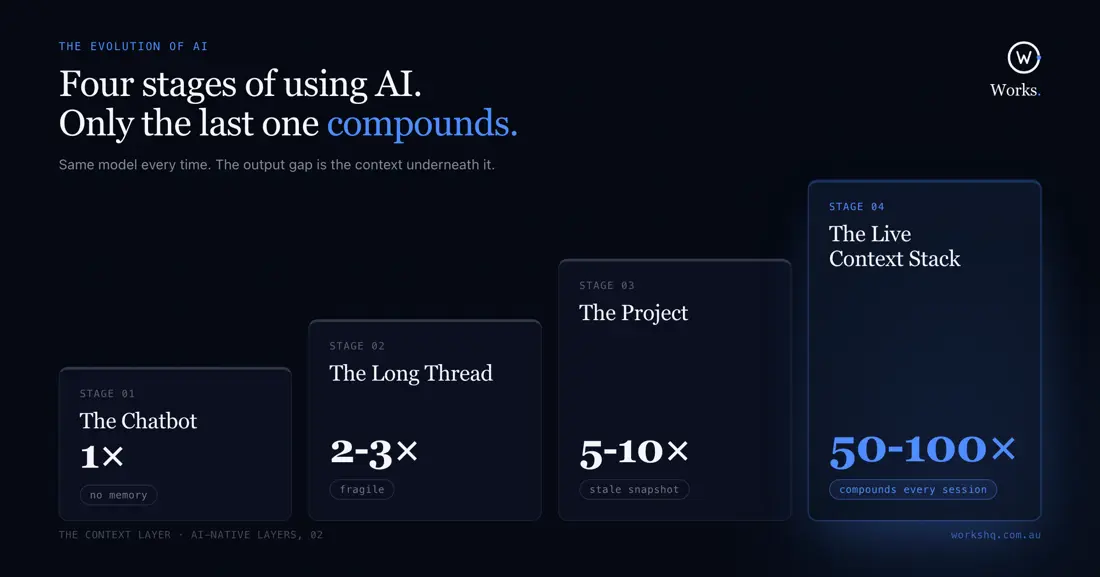
The compounding curve, from my Southstart talk.
The full context stack
At rung four, "context" stops being one thing. It's a stack, assembled fresh every time the model does anything, and it took me a year of rabbitholing to properly get my head around it.
There are three sources feeding it, and you need all three.
Persistent files, the company brain. This is what's always true. Who you are, who you serve, how you talk, what you sell, the rules you want it to follow. It lives in plain markdown the AI reads before you type a single word. This is the layer I wrote about in The AI Architecture Layer, and it's the foundation everything else sits on.
Live connections, the wires. This is what's true right now. The model reaching straight into Gmail, your CRM, Slack, Stripe, your docs, and reading the current state. Not a photocopy from last month. The actual number, the actual thread, the actual deal stage, today. This is the rung-three-to-four jump in a single move.
Tools, the reach. This is what it can go and get. Search the web, pull a transcript, run a calculation, query a database. When the answer isn't already in front of it, it goes and finds it instead of guessing.
Stack those three and the question stops being "how do I prompt this better." It becomes "does the model have what it needs to get this right." Almost always, the answer is no, and the fix isn't a cleverer prompt. It's better context.
That's the slide I put up at Southstart this year. Context, persistent files, live connectors, tools, all feeding the same model. For a lot of the room it was the first time AI looked like more than a chatbot with a text box, and you could watch it land.
More context is not better context
This next part trips a lot of us up, me included.
Once you realise context is the game, the instinct is to shovel everything in. Upload all 200 documents. Dump the entire history into the thread. Feels thorough. It's actually the fastest way to make the output worse.
Every leading model degrades as you fill it up. Chroma ran the test across eighteen frontier models last year and every single one got worse as the input grew, often long before the window was technically full. A model with a 200,000 token window can start dropping the ball at 50,000. The window keeps getting bigger and the performance keeps getting worse the more you stuff in.
So the skill isn't "give it everything." It's "give it the smallest set of current, relevant information that gets this specific task done, and nothing more." A tight map beats a giant transcript every time. You point the worker at the right cabinet, the right binder, the right page, not the whole building.
That's why the live wiring matters so much. It lets the model pull the small, exact slice it needs at the moment it needs it, instead of you pre-loading a giant pile and praying.
And context is not something you build once and leave. It's alive. Your pipeline, your pricing, your team, your priorities, all of it moves week to week, so the context has to move with it, or you're straight back to reading a stale photocopy. Keeping that current by hand is a losing game. Nobody has time to re-upload their whole business every Monday. That's exactly where the architecture earns its place. A proper system pulls the current version from your live tools, hands the model only the slice the task needs, and writes the new decisions back into the files as you work, so the context keeps itself up to date instead of quietly rotting. You stop maintaining context and start running on it.
Why this is the layer that decides everything
Context is the unglamorous middle of the stack. It doesn't demo well. It's some markdown files and a few connections. No animation, no viral screenshot.
But it's the layer that decides whether your AI feels like a magic trick that fades by message thirty, or a colleague that gets sharper every week. The skill you build next month is only as good as the context it reads from. The agent you stand up next quarter starts sharp or starts lost depending on what it can see. Tool choice barely matters. Claude, ChatGPT, Gemini, whichever. They all live or die on the context stack underneath them.
This is the problem Works exists to solve. We go into Australian businesses and build the live context layer into how you already work. The brain first, then the wires into your real systems, then the team trained to feed it, and only then the skills on top. My own one-man practice ran past $400k on exactly this stack, and I still can't write a line of code.
If your AI keeps forgetting who you are every morning, that's not the model failing. That's the context layer missing. That's the gap we close.
Let's get to Work!
Want this context layer built into your business?
Works embeds an operator who builds the context layer into how you already work. The brain, the live wires into your real systems, your team trained to feed it, then the skills on top. It starts with a 30-minute chat.
Book a call →Or score your AI readiness → Ten questions, a 0-100 score, and a tiered report on how ready you are.
Or start with the Works AI Audit → Fixed price: $5K for up to 50 people, $10K above that, and a build plan ranked by ROI that's yours either way.